日本語

Can CLIP 3D printing be used for mass production?

目次
CLIP as a Scalable Additive Manufacturing Technology
Continuous Production Advantage
Materials Suitable for Production Parts
Post-Processing for Production-Grade Parts
Industries Adopting CLIP for Production
Conclusion

CLIP as a Scalable Additive Manufacturing Technology

Continuous Liquid Interface Production (CLIP) is one of the most advanced resin-based additive manufacturing technologies available today. Unlike traditional layer-by-layer systems, CLIP uses a continuous curing process that significantly increases production speed and efficiency. The technology operates within the Vat Photopolymerization category, where liquid photopolymer resin is cured using projected ultraviolet light.

Through industrial 3D Printing Service providers, CLIP can produce highly detailed polymer components with excellent surface finish and consistent mechanical properties. Because the process eliminates many of the mechanical delays associated with traditional 3D printing, CLIP is increasingly considered suitable for scalable manufacturing rather than only prototyping.

In modern manufacturing workflows, CLIP printing can also complement other additive technologies such as Material Extrusion, Powder Bed Fusion, Binder Jetting, and hybrid repair technologies like Directed Energy Deposition. These combined processes enable manufacturers to select the most efficient production method depending on part geometry, material requirements, and production volume.

Continuous Production Advantage

The main reason CLIP technology can support mass production is its continuous printing mechanism. Traditional resin printing methods such as SLA require each layer to be individually cured, followed by mechanical repositioning of the build platform. This repetitive sequence slows the overall printing process.

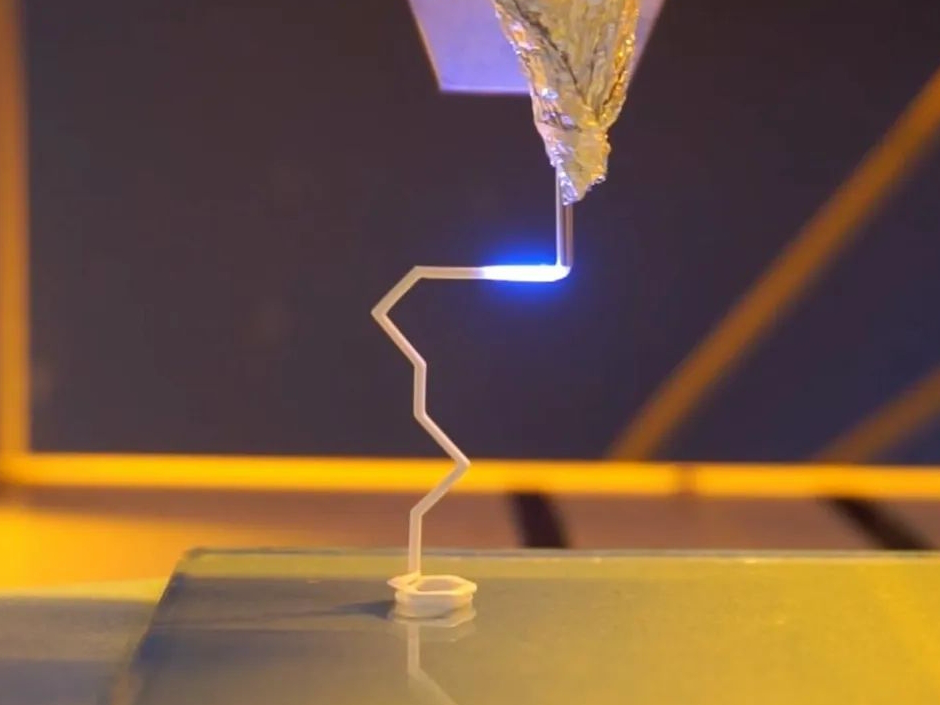
CLIP eliminates this stop-and-start cycle by creating a continuous printing environment. A controlled oxygen-permeable layer prevents resin from curing directly against the projection window, allowing liquid resin to flow beneath the growing part. As a result, components can be produced continuously rather than layer by layer.

This continuous curing process significantly increases production speed and allows multiple components to be manufactured efficiently within the same printing cycle, making the technology more suitable for high-volume production.

Materials Suitable for Production Parts

CLIP printing supports several advanced photopolymer materials that provide mechanical properties suitable for production components.

For many manufacturing applications, Standard Resins are used for high-detail components and product housings where surface quality and dimensional accuracy are important.

For more demanding applications that require improved mechanical performance, Tough Resins are commonly used to simulate the strength and durability of engineering plastics.

When flexibility and fatigue resistance are required, specialized materials such as Durable Resins provide enhanced impact resistance and long-term reliability.

Post-Processing for Production-Grade Parts

Even when CLIP printing is used for mass production, post-processing remains an important step to ensure final part performance. Precision finishing techniques such as CNC Machining may be applied to achieve tighter tolerances or refine specific features.

In high-temperature or harsh operating environments, protective treatments such as Thermal Barrier Coatings (TBC) can enhance thermal resistance and extend component service life.

Industries Adopting CLIP for Production

The ability to produce high-quality parts quickly makes CLIP attractive for several industries.

The Consumer Electronics industry uses CLIP printing to manufacture small precision housings, wearable device components, and product prototypes that transition into limited production runs.

In the Medical and Healthcare sector, CLIP technology enables the production of custom medical devices, dental products, and patient-specific treatment components.

Manufacturers in Manufacturing and Tooling also adopt CLIP printing to produce customized tooling, fixtures, and production aids at scale.

Conclusion

CLIP 3D printing is increasingly capable of supporting mass production thanks to its continuous photopolymerization process and high printing speed. By eliminating traditional layer-by-layer delays, CLIP can manufacture parts more efficiently than many other resin-based technologies.

When combined with advanced materials, precision post-processing, and optimized production workflows, CLIP technology offers a scalable additive manufacturing solution suitable for modern industrial production environments.

専門家による設計と製造のヒントをメールで受け取りたい方は購読してください。
この投稿を共有: