Polyamide 11 (PA11)
Polyamide 11 (PA11) 3D Printing Materials Introduction
Polyamide 11 (PA11) is a high-performance engineering thermoplastic known for its excellent toughness, ductility, and impact resistance in additive manufacturing. Compared with many conventional nylons, PA11 offers lower brittleness, better flexibility, and strong resistance to repeated loading, making it highly suitable for functional parts exposed to dynamic service conditions.
Through advanced plastic 3D printing, PA11 is widely used to manufacture lightweight yet durable components with complex geometries. Its balanced mechanical profile makes it especially valuable in aerospace, automotive, industrial equipment, and consumer applications requiring snap-fit behavior, impact durability, and long-term dimensional stability.
Polyamide 11 (PA11) Similar Grades Table
The table below lists equivalent grades of Polyamide 11 in various international standards and common commercial designations:
Country/Region | Standard | Grade Name or Designation |
|---|---|---|
USA | ASTM | PA11 |
Germany | DIN | PA11 |
ISO | ISO 1874 | PA11 |
France | Trade Name | Rilsan® PA11 |
International | Generic | Polyamide 11 |
Polyamide 11 (PA11) Comprehensive Properties Table
Category | Property | Value |
|---|---|---|
Physical Properties | Density | 1.03 g/cm³ |
Melting Point | 185–190°C | |
Water Absorption | Low to Moderate | |
Thermal Conductivity | 0.26 W/(m·K) | |
Service Temperature | Up to approximately 100–120°C | |
Mechanical Properties | Tensile Strength | 45–52 MPa |
Yield Strength | 40–48 MPa | |
Elongation at Break | 30–50% | |
Flexural Modulus | 1300–1600 MPa | |
Impact Resistance | Excellent | |
Chemical Properties | Chemical Resistance | Good resistance to oils, greases, and fuels |
Weather Resistance | Good |
3D Printing Technology of Polyamide 11 (PA11)
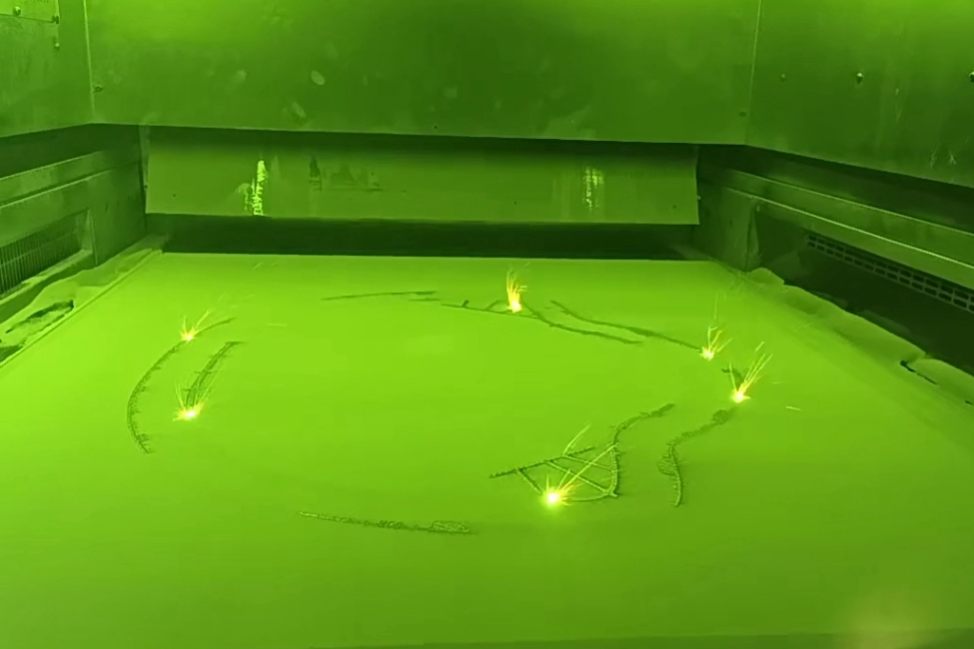
Commonly employed technologies for printing Polyamide 11 include Selective Laser Sintering (SLS) and, in some applications, powder-based production routes for functional polymer components. These methods take advantage of PA11’s toughness and flexibility, enabling complex support-free geometries, strong interlayer bonding, and reliable performance in load-bearing plastic parts.
Applicable Process Table
Technology | Precision | Surface Quality | Mechanical Properties | Application Suitability |
|---|---|---|---|---|
SLS | ±0.1–0.3 mm | Ra 6.3–12.5 µm | Excellent Toughness | Industrial housings, ducts, clips |
MJF | ±0.08–0.25 mm | Ra 6–10 µm | Very Good | Functional batch parts, covers |
Polyamide 11 (PA11) 3D Printing Process Selection Principles
When toughness, flexibility, and design freedom are the main priorities, Selective Laser Sintering (SLS) is the preferred choice. It supports complex self-supporting shapes and delivers reliable performance for structural polymer parts, especially when ductility is more important than maximum stiffness.
For repeatable production with more uniform part quality and improved dimensional consistency, powder bed fusion workflows are highly suitable. These processes help maintain stable batch quality in industrial PA11 production and are appropriate for functional end-use parts with medium-volume demand.
Polyamide 11 (PA11) 3D Printing Key Challenges and Solutions
One of the main challenges in PA11 printing is powder condition control. Aged or moisture-exposed powder can negatively affect fusion quality and final mechanical consistency. Maintaining sealed storage, humidity control, and optimized powder refresh ratios helps preserve stable processing behavior and part performance.
Warping and dimensional deviation may appear in larger flat components due to uneven heat distribution during printing. Proper build orientation, balanced wall design, and process parameter optimization reduce deformation and improve dimensional accuracy in functional parts.
Surface roughness is another common concern in powder-based polymer printing. For sealing surfaces, fitting features, or improved aesthetics, post-processing methods such as CNC machining, polishing, or additional surface treatment can significantly improve final part quality.
For applications involving outdoor exposure or repeated chemical contact, material validation is recommended. PA11 generally provides strong chemical resistance and impact behavior, but final performance should still be matched to the real-use environment and service temperature.
Industry Application Scenarios and Cases
Polyamide 11’s toughness and lightweight performance make it suitable for a wide range of demanding industries:
Aerospace and Aviation: Lightweight ducts, clips, covers, and cabin support components requiring impact resistance and low mass.
Automotive: Airflow channels, protective housings, under-hood brackets, and functional prototypes exposed to vibration and thermal cycling.
Robotics: Flexible covers, lightweight structural parts, and cable-management components benefiting from toughness and fatigue resistance.
In practical applications, PA11 is often selected for functional housings and snap-fit parts because it combines lower brittleness with durable repeated-use performance, helping reduce weight while maintaining reliable structural integrity.
FAQs
What are the main advantages of Polyamide 11 over other nylon materials in 3D printing?
Which 3D printing technology is most suitable for PA11 functional parts?
How does PA11 perform in impact-resistant and snap-fit applications?
What post-processing methods are commonly used for PA11 printed parts?
Which industries benefit most from Polyamide 11 3D printing?
Explore Related Blogs