Nylon 12 PA12
Nylon 12 (PA12) 3D Printing Materials Introduction
Nylon 12 (PA12) is a high-performance engineering thermoplastic widely used in additive manufacturing for its excellent balance of strength, flexibility, and chemical resistance. Compared to other polyamides, PA12 exhibits lower moisture absorption and superior dimensional stability, making it particularly suitable for precision functional parts.
Through advanced plastic 3D printing, Nylon 12 enables the production of complex geometries with consistent mechanical performance. It is extensively applied in aerospace, automotive, and industrial sectors for components such as housings, ducts, connectors, and snap-fit assemblies where durability and lightweight properties are critical.
Nylon 12 (PA12) Similar Grades Table
The table below lists equivalent grades of Nylon 12 across different standards and suppliers:
Country/Region | Standard | Grade Name or Designation |
|---|---|---|
USA | ASTM | PA12 |
Germany | DIN | PA12 |
ISO | ISO 1874 | PA12 |
Trade Name | Arkema | Rilsamid® PA12 |
Trade Name | Evonik | VESTOSINT® PA12 |
Nylon 12 (PA12) Comprehensive Properties Table
Category | Property | Value |
|---|---|---|
Physical Properties | Density | 1.01 g/cm³ |
Melting Point | 178–180°C | |
Water Absorption | Low (~0.8%) | |
Thermal Conductivity | 0.25 W/(m·K) | |
Mechanical Properties | Tensile Strength | 45–50 MPa |
Elongation at Break | ≥20% | |
Flexural Modulus | 1500–1700 MPa | |
Impact Strength | Excellent | |
Hardness | Shore D 70–75 | |
Chemical Properties | Chemical Resistance | Excellent (oils, fuels, solvents) |
UV Resistance | Moderate (improvable with additives) |
3D Printing Technology of Nylon 12 (PA12)
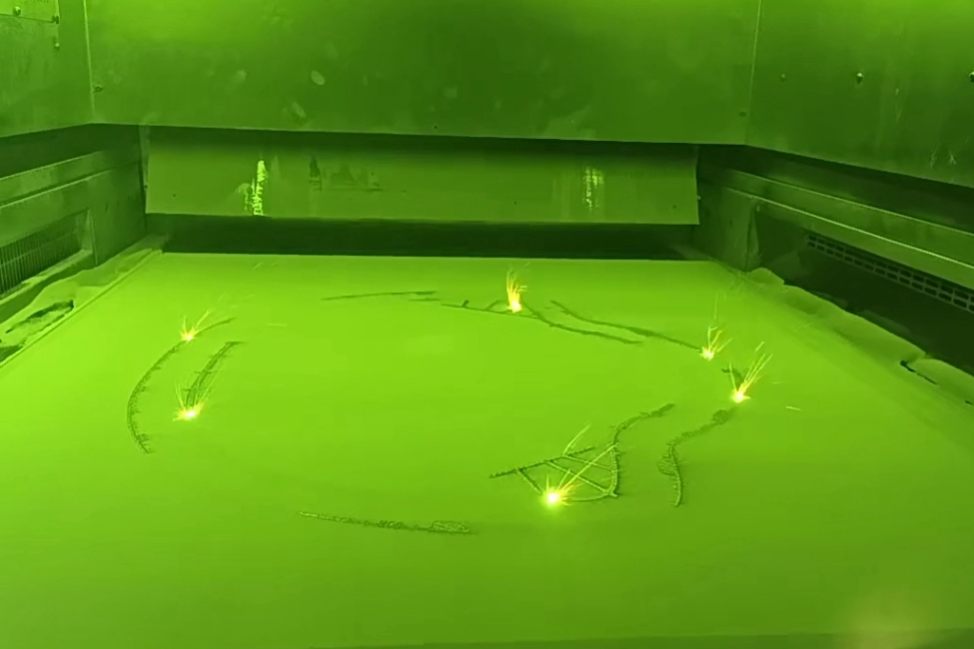
Nylon 12 is most commonly processed using Selective Laser Sintering (SLS) and Multi Jet Fusion (MJF), both of which enable high precision and excellent mechanical properties. These powder-based technologies allow for support-free fabrication of complex geometries, making PA12 ideal for functional prototypes and end-use parts.
Applicable Process Table
Technology | Precision | Surface Quality | Mechanical Properties | Application Suitability |
|---|---|---|---|---|
SLS | ±0.1–0.3 mm | Ra 6–12 µm | Very Good | Functional prototypes, housings |
MJF | ±0.08–0.2 mm | Ra 6–10 µm | Excellent | End-use parts, batch production |
Nylon 12 (PA12) 3D Printing Process Selection Principles
For complex geometries and cost-effective production, Selective Laser Sintering (SLS) is widely used. It enables support-free printing and is suitable for functional prototypes and medium-volume production.
When higher consistency and better surface uniformity are required, Multi Jet Fusion (MJF) offers improved mechanical performance and repeatability, making it ideal for end-use industrial components.
Nylon 12 (PA12) 3D Printing Key Challenges and Solutions
Powder aging and reuse can affect mechanical consistency. Implementing strict powder refresh ratios and controlled storage environments ensures stable part quality and repeatability.
Surface roughness is inherent in powder-based printing processes. Post-processing methods such as CNC machining or polishing can significantly improve surface finish and aesthetic quality.
Dimensional accuracy can be influenced by thermal shrinkage. Optimized build orientation and compensation algorithms help maintain tight tolerances and reduce deformation.
Industry Application Scenarios and Cases
Nylon 12 is widely used across multiple industries due to its lightweight and durable characteristics:
Aerospace and Aviation: Lightweight ducts, brackets, and interior components.
Automotive: Functional housings, air intake manifolds, and connectors.
Robotics: Durable enclosures and motion system components.
A recent application demonstrated that PA12 printed functional housings reduced weight by 40% while maintaining structural integrity compared to traditional injection-molded parts.
FAQs
Explore Related Blogs