How does SLS compare to MJF for Nylon 12 production?
Both are powder bed fusion technologies, but MJF generally outperforms SLS in most production-oriented metrics for Nylon 12, except for some specific niche advantages of SLS.
Quick Summary
Choose MJF if you need high-volume production, excellent surface finish, fine details, and consistent isotropic mechanical properties.
Choose SLS if you have a lower budget, need to print very large parts (build volume limited by MJF's current max size), or require very specific material blends (e.g., flame-retardant or carbon-fiber filled Nylon 12 where MJF options are rarer).
Detailed Comparison Table (Nylon 12)
Feature | SLS | MJF |
|---|---|---|
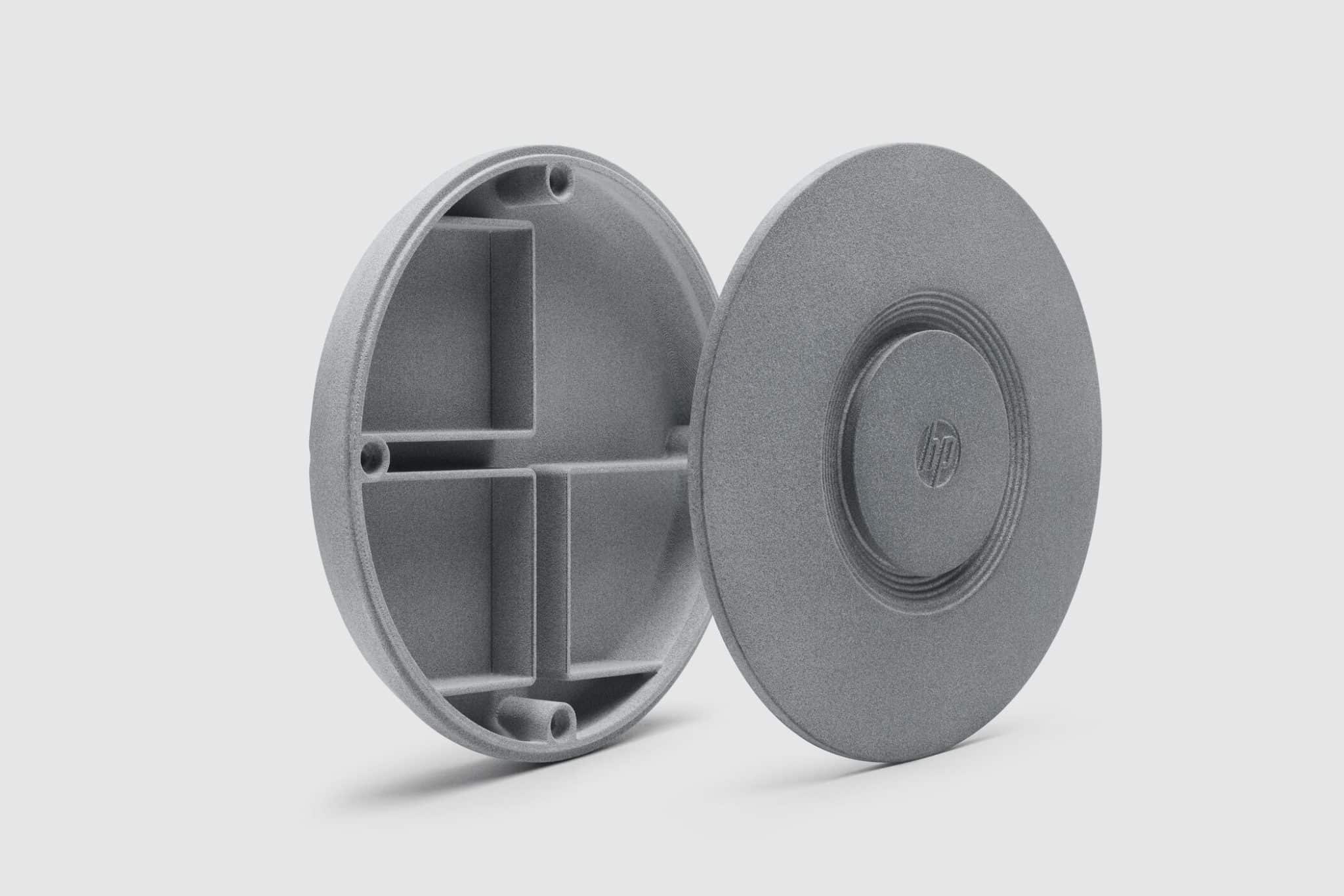
Surface Finish | Gritty, sandy texture (similar to fine sandstone). Requires bead blasting for smoothing. | Smooth, slightly matte finish. Much closer to injection-molded plastic. |
Feature Resolution | Good (~0.3-0.5 mm minimum detail). Laser spot size limits sharp corners. | Excellent (~0.2 mm). Can produce sharper edges, fine text, and small holes more reliably. |
Mechanical Strength (Tensile) | Good (45-50 MPa). Slightly lower Z-axis strength (anisotropic). | Slightly higher (48-52 MPa). Near-isotropic (strength similar in all axes). |
Elongation at Break | ~15-25% (more ductile, better impact resistance in some blends). | ~10-20% (stiffer, slightly less elongation than SLS with same PA12). |
Accuracy / Tolerances | ±0.3% or ±0.3 mm (larger parts can warp more). | ±0.2% or ±0.2 mm (more consistent across build plate due to uniform heating). |
Build Speed | Slow (laser scans each point). One part or many parts takes similar time per layer. | Fast (entire layer fused at once with IR lamps). More parts = better throughput. |
Cost per Part (Low Volume) | Lower (machine and material cheaper for small batches). | Higher (machine cost is higher, but material is similar). |
Cost per Part (High Volume) | Higher (speed is the bottleneck). | Much lower – excellent for production runs (100+ parts). |
Material Refresh Ratio | Usually 30-50% fresh powder mixed with used powder. | Typically 30-80% fresh powder needed (HP recommends ~30% for PA12). |
Powder Reusability | Powder degrades with heat exposure. Multiple reuses reduce mechanical properties. | Better consistency across reused powder due to less thermal exposure during printing. |
Post-Processing | Requires bead blasting to remove stuck powder. Manual labor intensive. | Most powder falls off easily. Automated cleaning possible. |
Build Volume (typical) | Large (e.g., 300x300x400 mm up to 750x750x550 mm). | Smaller (e.g., 380x284x380 mm for HP 5200). Large-format MJF is rare. |
Key Technical Insights
1. Mechanical Properties & Anisotropy
SLS: Because the laser creates a melt pool with directional cooling, parts are noticeably weaker in the Z-axis (vertical direction) – typically 15-20% lower tensile strength and elongation compared to XY.
MJF: The IR lamp fuses the entire layer simultaneously and more uniformly. This results in near-isotropic properties (Z-strength >85-90% of XY strength). For structural Nylon 12 parts, MJF is significantly better.
2. Surface Quality & Fine Features
MJF parts look and feel closer to injection-molded nylon. SLS parts have a characteristic "orange peel" or sandy finish that may require secondary operations (vapor smoothing, tumbling) for aesthetic or low-friction applications.
MJF can print closed-cell lattice structures with thinner walls (0.5 mm vs SLS's ~0.8-1.0 mm reliably).
3. Throughput & Production Economics
MJF shines at batch production. If you need 500 identical Nylon 12 clips, MJF will finish in a fraction of the time and at lower per-part cost than SLS.
SLS remains competitive for low-volume or large-part scenarios. For a single prototype or a part that fills a 500x500x400 mm build volume, SLS may be the only option (MJF max build is usually smaller).
4. Material Flexibility
SLS has a wider ecosystem of Nylon 12 blends: glass-filled, carbon-fiber-filled, aluminum-filled, flame-retardant, and flexible copolymers (TPU blends).
MJF offers fewer third-party materials. HP's official PA12 and PA12 glass-filled are excellent, but exotic blends are limited.
Recommendation for Nylon 12 Production
If your priority is... | Choose... |
|---|---|
Highest surface quality (consumer goods, enclosures) | MJF |
Best Z-axis strength (functional hinges, snap-fits) | MJF |
High volume / low per-part cost (500+ pieces) | MJF |
Very large parts (drone frames, automotive ducts) | SLS |
Low initial investment (prototyping on a budget) | SLS |
Special filled materials (e.g., CF-PA12 for stiffness) | SLS (or consider MJF with glass-filled PA12) |
Bottom line: For pure Nylon 12 production (not exotic blends), MJF has surpassed SLS in most metrics except maximum build size and machine purchase price. If you are outsourcing to a service bureau, ask for MJF first – you'll get stronger, prettier parts faster. If you are buying your own machine and budget is tight, SLS is still very capable.