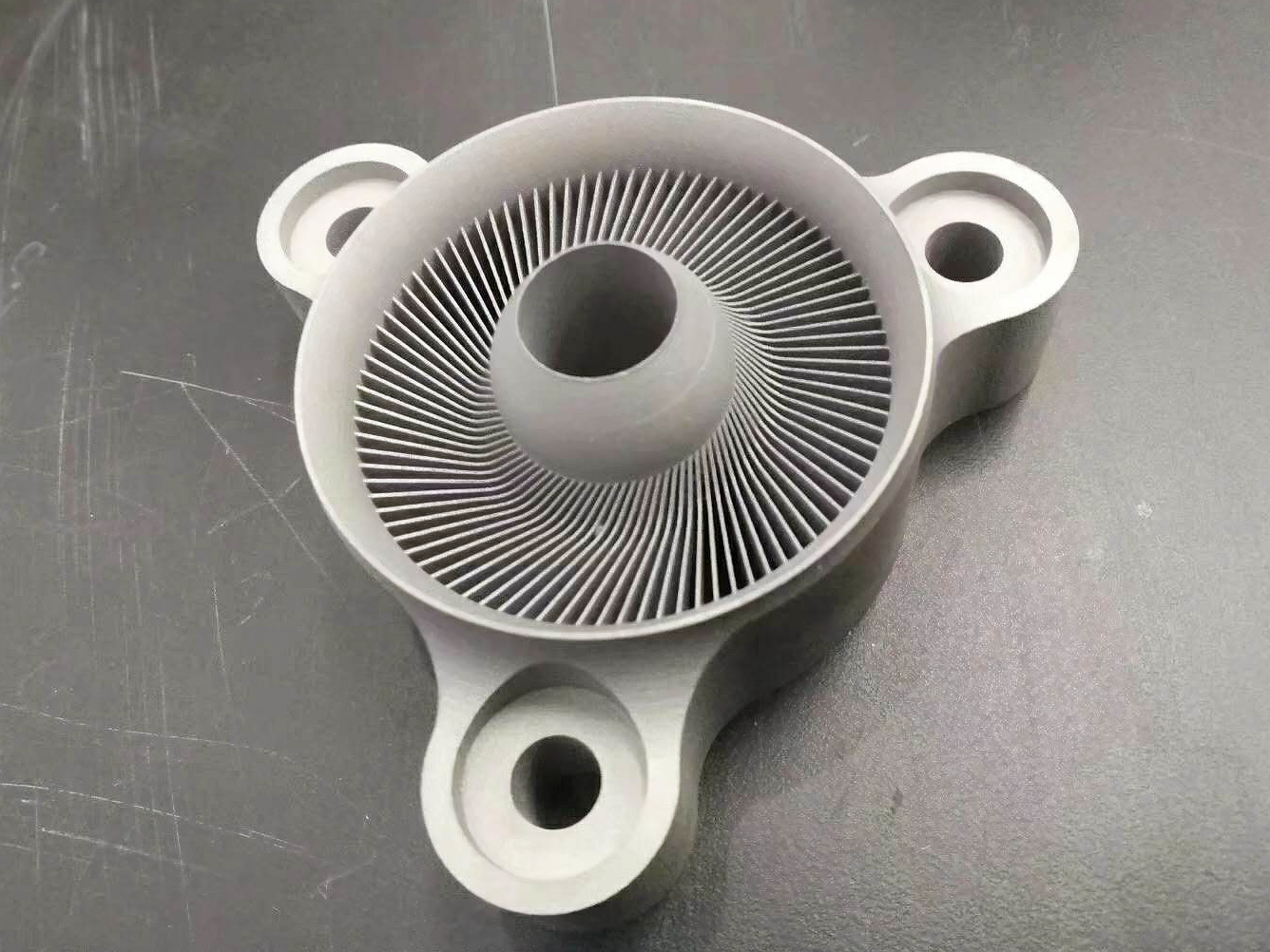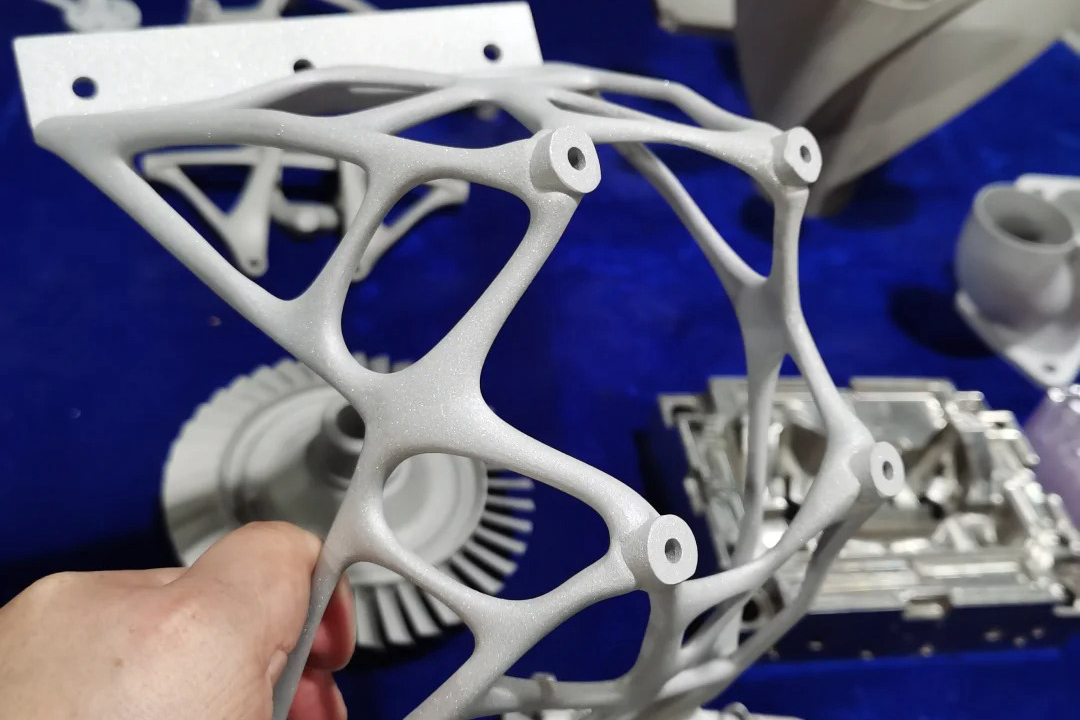
There is no universal best process for every aerospace stainless steel part. Laser powder bed fusion is usually the first route to screen for a complex, low-volume bracket, manifold, or housing because it can form internal features without hard tooling. That recommendation is conditional on the grade, build orientation, support strategy, heat-treatment condition, final machining, and acceptance evidence. Stainless Steel 3D Printing should be quoted against the final delivered state rather than the as-built surface or machine resolution.
Laser powder bed fusion melts a qualified powder track by track. Its main controls are energy input, powder condition, thermal management, orientation, support removal, and inspection access. It can suit a thin-walled manifold or topology-optimized bracket, but residual stress can move a datum after support cutting. A high density result from a witness coupon does not prove that a tall thin wall or a closed passage has the same defect population.
For an aerospace stainless steel component, this thermal history matters because the melt-pool overlap and cooling gradient influence porosity, residual stress, surface condition, and the direction of a fatigue-sensitive load path. The effect must be checked in the specified grade, orientation, and final heat-treatment state rather than inferred from the process name.
Binder jetting creates a powder and binder green body, followed by debinding and sintering. It becomes interesting when many small stainless components can be nested and the customer can qualify shrinkage, furnace position, density, and accepted yield. It is less attractive when a single aerospace part needs a tight fired datum or when trapped powder and furnace distortion are difficult to verify. The relevant comparison is cost per accepted part, not cost per printed green part.
EBM and DED should be treated as material-specific qualification routes. EBM uses vacuum and elevated bed temperature, which changes thermal history, surface texture, powder removal, and feature limits. DED adds material to a substrate and requires control of dilution, interface fusion, bead geometry, and machining allowance. A vacuum or a controlled melt pool does not automatically establish fatigue life or aerospace approval. Powder Bed Fusion is a process family, not a substitute for the machine and material qualification record.
316L is considered when corrosion resistance, ductility, and weldability are important. Its aerospace suitability still depends on fluid, temperature, chloride exposure, surface condition, and cleaning. Do not transfer a corrosion claim from a polished coupon to a rough internal passage. Specify the environment and the required passivation or surface condition.
17-4 PH and 15-5 PH are precipitation-hardening grades. Their strength and toughness depend on solution treatment, aging condition, section size, and orientation. H900 and H1025 are different conditions and can change hardness, ductility, corrosion behavior, and dimensional stability. Heat Treatment must be part of the grade definition. The RFQ should name the condition and require a furnace record, hardness result, and the tensile or fatigue evidence appropriate to the load.
Stress relief may be needed before cutting supports or rough machining, but it does not prove zero distortion. HIP can reduce some internal pores under a qualified cycle, but it cannot repair an open surface crack, wrong chemistry, or a misplaced datum. CNC machining can establish a bore or mounting face if the design includes enough allowance and the heat-treatment movement is known. Surface treatment and passivation require a compatible cleaning process; they do not hide a crack that should be rejected.
For a pressure or fluid component, verify passage continuity, residual powder removal, pressure or leak performance, critical dimensions, and surface condition. For a load-bearing bracket, verify orientation, heat-treatment condition, hardness, dimensions, surface defects, and representative tensile or fatigue data. Use CT or metallography when internal defects are part of the acceptance plan. Coupon results should be traceable to the same powder lot, build, orientation, and final condition as the part.
316L fluid manifold. Choose laser powder bed fusion when the curved passages reduce assembly count and the quantity is low. Before release, define the fluid, pressure, temperature, cleaning route, leak criterion, datum scheme, and channel inspection method. Hold the lot if a channel cannot be cleaned or a pressure result is not linked to the final condition.
17-4 PH actuator bracket. Choose laser powder bed fusion when weight reduction and integrated mounting features justify the process. Set the aging condition before build orientation, then review support removal and machining distortion. Verify hardness, critical dimensions, surface defects, and the agreed mechanical evidence after heat treatment. A bracket that matches CAD in the as-built state is not accepted until its machined and aged interfaces are within the drawing limits.
Provide the CAD revision, quantity, grade, powder lot, build orientation, minimum wall, channel access, load spectrum, service temperature, environment, heat-treatment condition, machining allowance, surface finish, final state, and delivery documentation. Request the parameter revision, build record, atmosphere record, heat-treatment chart, dimensional report, defect method, and representative coupon relationship. ASTM F3184 may be considered for applicable UNS S31603 laser powder bed fusion work; ASTM F3303 may be applicable to a specified stainless laser powder bed fusion route; ASTM E8/E8M and ASTM E466 may be selected for tensile and fatigue methods. These references do not set a universal aerospace pass value. The quality plan must define the method, specimen condition, uncertainty, acceptance limit, retest rule, and disposition authority.
Screen laser powder bed fusion first for complex low-volume stainless parts, compare binder jetting when nested accepted yield matters, and use EBM or DED only with route-specific evidence. Choose the grade and thermal condition from the actual service load and environment. Release only when the final part, not merely the print or coupon, meets the approved dimensional, defect, material, surface, and application criteria.