How does Multi Jet Fusion (MJF) benefit the production of plastic parts for consumer electronics?
How does Multi Jet Fusion (MJF) benefit the production of plastic parts for consumer electronics?
MJF can benefit consumer-electronics production when the part needs a complex plastic housing, integrated clips or guides, low-to-medium volume, and repeatable build packing. It uses fusing and detailing agents with a heated polymer powder bed, commonly PA12, PA11, or another qualified polyamide. The benefit is conditional on agent control, powder history, cooling, conditioning, cosmetic finishing, and functional inspection. MJF is not automatically a replacement for injection molding or a proof of identical properties in every direction; compare it with SLS when the nylon material state is the main decision.
Geometry and Part Integration
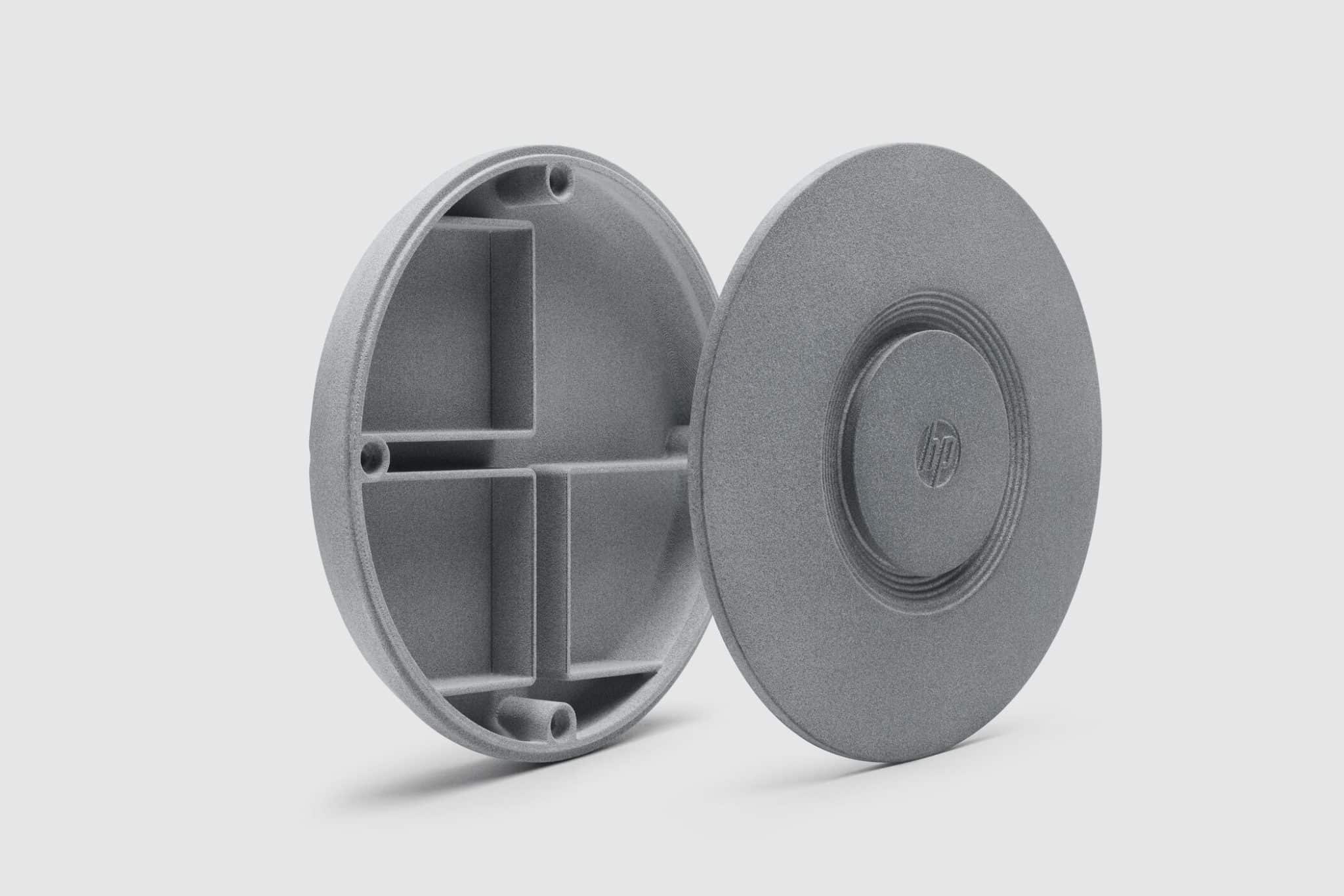
MJF can consolidate a housing, cable guide, latch, mounting boss, and strain-relief feature into fewer pieces. The fusing agent changes where polymer powder consolidates, while the detailing agent changes edge definition; because the resulting thermal history affects shrinkage, warpage, and surface texture, those outputs need a build-specific check. That can reduce assembly operations and alignment interfaces, but it also concentrates risk in one printed part. Define wall thickness, boss geometry, minimum radii, latch travel, powder-removal openings, and machining access. A sealed electronics enclosure needs a separate assessment of gasket compression, flatness, ingress path, and chemical wipe exposure. A packed build is useful only if every critical part can be depowdered and inspected.
MJF's agent placement and cooling schedule also affect the local fusion depth and the edge transition around a thin wall. Because a device enclosure has connector openings, bosses, and cosmetic faces in the same build, inspect those areas separately after conditioning. A build record that lists only the machine name cannot explain a warped opening or a failed latch.
For a consumer-electronics shell part, choose MJF when integrated features and short-run customization outweigh the cost of tooling, then verify connector alignment, latch cycles, drop performance, and cosmetic zones after conditioning. The agent map, build position, cooling history, and PA12 condition must be recorded so a local failure can be traced to geometry, thermal history, conditioning, or finish.
For an internal device frame component, choose MJF when packed production and part consolidation are valuable, then verify screw-boss pull-out, vibration, thermal cycling, and the final mating datums. The frame should be accepted only against the final finish and conditioning state, because a flat coupon does not represent the connector and boss interfaces.
For a wearable shell, evaluate drop energy, skin-contact finish, strap or hinge cycling, sweat or cleaning-fluid exposure, and color consistency. For an internal frame, evaluate screw-boss pull-out, connector alignment, vibration, and thermal expansion. The MJF process route should identify the cosmetic zones and the functional datums before a build is quoted.
Surface and Dimensional Control
MJF surfaces have a powder-derived texture that can be improved with blasting, tumbling, dyeing, sealing, or painting. Each finish changes color, roughness, dimensions, and sometimes friction or chemical resistance. Measure the final shell, latch, connector opening, and gasket face after the selected treatment. A surface roughness value from an as-built coupon should not be transferred to a painted or sealed production housing without checking the delivered state.
Polyamide can absorb moisture, which changes dimensions and mechanical response. Define the conditioning period and humidity before evaluating snap fits or mating covers. Use a dimensional map to identify distortion across the build. Check thin walls, long edges, bosses, and openings rather than relying on one overall measurement. If a finer cosmetic surface is required, compare powder-bed fusion options after confirming that the selected finish does not close a vent or alter a critical fit.
Throughput and Accepted-Unit Economics
MJF can pack many small parts into a build, so the process may be attractive for customized accessories, short-run housings, and design revisions. Compare accepted units per build, powder and agent consumption, cooling time, depowdering, finishing, inspection, and rework. A faster build stage does not establish a lower cost if cosmetic rejects or warped mating faces reduce yield. At higher volume, compare MJF with molding using the tooling amortization, revision schedule, and target quantity. A short-run buyer should request an accepted-unit estimate rather than only a nominal build-time estimate.
Consumer-Electronics Failure Controls
Typical risks include local warpage, incomplete fusion, powder trapped in a cavity, brittle screw bosses, latch fatigue, rough gasket faces, color variation, and moisture-driven fit change. Control powder lot, agent and machine records, build orientation, cooling, depowdering, conditioning, and finish according to the approved MJF window. Inspect with CMM or gauges for critical datums, optical measurement for openings and cosmetic features, and CT or sectioning for inaccessible cavities. Run drop, latch-cycle, screw-boss, vibration, thermal-cycle, or chemical-wipe tests according to the product duty.
ASTM D638 or ASTM D790 may support polymer tensile or flexural characterization when accepted by the project specification. Application release should also identify specimen orientation, humidity, temperature, final finish, measurement uncertainty, and acceptance limit. Hold any part outside the approved criterion for engineering disposition rather than changing the criterion after production. When the enclosure seals a sensitive assembly, add an ingress, gasket compression, or leak-related check that represents the final finish and mating hardware.
MJF RFQ and Release
Provide the CAD and drawing revision, PA12 or approved material, quantity, build packing expectation, wall and boss dimensions, drop or vibration duty, temperature and humidity, cleaning chemicals, cosmetic zones, color, latch and connector requirements, gasket or sealing surfaces, final finish, conditioning, inspection method, documentation, and delivery milestone. Request material and powder records, agent or machine records, cooling and depowdering records, dimensional data, surface data, functional tests, and signed deviation disposition. MJF adds value when its accepted-unit yield and final evidence support the actual consumer-electronics requirement.
If this question concerns a failure mechanism, compare the plastic 3d printing after the suspected cause and test condition are identified.
For a controlled production decision, request the plastics when the final state and deviation path need traceable evidence.