Inconel 718 vs Titanium TC4: Compare Strength for Your Custom 3D Printed Parts
Introduction
Inconel 718 and Titanium TC4 (Ti-6Al-4V) are two of the most widely used alloys in metal 3D printing, each offering unique advantages in strength, weight, and performance. Aerospace, energy, medical, and industrial sectors rely heavily on these materials for custom components where strength-to-weight ratio and durability are critical.
Selecting the optimal alloy depends on the specific requirements of the application: high tensile and fatigue strength, elevated temperature resistance, corrosion resistance, and manufacturability. Comparing these two alloys from both a mechanical and process perspective is essential for making the right material choice.
In this guide, we will analyze the superalloy 3D printing capabilities of Inconel 718 alongside titanium 3D printing with TC4. We will compare their strength profiles, printability, post-processing needs, and application suitability to help engineers and buyers choose the best alloy for their custom 3D-printed parts.
Material Composition and Metallurgical Differences
Alloy Composition
Inconel 718 is a nickel-based superalloy known for its high strength and corrosion resistance at elevated temperatures. Its composition typically includes 50–55% nickel, 17–21% chromium, 2.8–3.3% molybdenum, 4.75–5.5% niobium (plus tantalum), and smaller amounts of titanium and aluminum. This complex alloying enables Inconel 718 to maintain mechanical integrity up to 700–750 °C.
Ti-6Al-4V TC4, classified as Grade 5 titanium, is an α-β titanium alloy composed of 6% aluminum and 4% vanadium, with the balance being titanium. It offers an excellent combination of high strength, corrosion resistance, and biocompatibility. With a much lower density than Inconel 718, TC4 is well-suited for applications requiring lightweight, high-strength components.
Strengthening Mechanisms
Inconel 718 derives its superior mechanical properties through precipitation hardening. Heat treatment promotes the formation of gamma prime (γ’) and gamma double prime (γ’’) precipitates, which provide exceptional strength and fatigue resistance, especially under cyclic loading and elevated temperatures.
In contrast, TC4 relies on alpha-beta phase strengthening. The alloy's microstructure can be tailored via heat treatment to balance strength and ductility. The α-phase imparts excellent creep resistance, while the β-phase enhances tensile strength and toughness. This versatility makes TC4 popular across aerospace, medical, and industrial sectors.
Both alloys respond well to Powder Bed Fusion 3D printing processes, though Inconel 718 typically requires more careful control of build parameters due to its susceptibility to residual stress and distortion.
In summary, while both Inconel 718 and TC4 offer excellent strength and performance, their metallurgical differences dictate their optimal applications: Inconel 718 for extreme thermal and fatigue environments, TC4 for lightweight, high-strength components where corrosion resistance is critical.
Mechanical Strength Comparison
Tensile and Yield Strength
One of the most important considerations when selecting between Inconel 718 and Titanium TC4 is tensile and yield strength.
Inconel 718, after full precipitation hardening, exhibits exceptional mechanical strength at room and elevated temperatures. Typical values include tensile strength of 1,240–1,400 MPa and yield strength of approximately 1,030–1,100 MPa. Even at temperatures approaching 650–700 °C, Inconel 718 maintains structural integrity, making it ideal for hot-section components in aerospace and energy turbines.
Titanium TC4 offers an excellent strength-to-weight ratio. At room temperature, TC4 typically achieves tensile strength around 900–1,000 MPa and yield strength of 850–900 MPa. While these values are slightly lower than Inconel 718, TC4's density is just 4.43 g/cm³ compared to Inconel 718’s 8.19 g/cm³. For weight-sensitive designs, TC4 delivers significant mass savings.
Fatigue Strength
In cyclic loading conditions, fatigue strength becomes critical.
Inconel 718 excels in high-cycle fatigue environments, maintaining fatigue strength of 550–600 MPa under typical aerospace loading conditions. Its fatigue resistance remains stable even at elevated temperatures, contributing to its widespread use in aerospace and aviation turbine disks and rotating machinery.
Titanium TC4 also offers good fatigue strength (~500–550 MPa at room temperature), particularly in atmospheric or biomedical environments. TC4’s surface finish and post-processing quality are crucial to maximizing fatigue life, which is why Powder Bed Fusion parameters and finishing processes must be carefully controlled.
Creep Resistance at High Temperatures
When operating under sustained stress at high temperatures, creep resistance is essential.
Inconel 718 offers excellent creep resistance, maintaining dimensional stability at 600–700 °C under load for prolonged periods. This is one of the reasons it dominates in energy and power applications such as turbine shafts and combustor components.
Titanium TC4, while strong, is not designed for extremely high-temperature creep environments. Its service temperature typically tops out around 350–400 °C. Beyond this, significant strength degradation occurs.
3D Printing Performance and Post-Processing
Printability and Build Challenges
Both Inconel 718 and Titanium TC4 are compatible with Powder Bed Fusion technology, but their behaviors during the build process differ.
Inconel 718 is a high-strength nickel alloy prone to significant residual stress buildup during printing due to its high thermal gradients. Without optimized scan strategies and preheating, parts may exhibit warping or cracking. Additionally, its complex precipitation-hardened microstructure requires tight control over layer thickness, energy input, and build orientation to ensure part integrity.
Titanium TC4, in contrast, is one of the most user-friendly metals to 3D print. It exhibits excellent printability with low residual stress and minimal warping. TC4 also supports faster build rates, making it more cost-effective for large structures or batch production runs. Its consistent behavior across build platforms contributes to its popularity for titanium 3D printing in aerospace and medical sectors.
Post-Processing Requirements
Inconel 718 requires a stringent heat treatment sequence after printing. A full solution treatment followed by double aging is necessary to precipitate γ’ and γ’’ phases, achieving optimal strength and fatigue properties. Additional hot isostatic pressing (HIP) is recommended for aerospace or high-performance applications to eliminate porosity and improve fatigue life.
Titanium TC4 typically undergoes a stress relief anneal or HIP, depending on performance requirements. Since TC4’s as-printed microstructure already delivers good strength, post-processing is generally simpler and less time-consuming than with Inconel 718.
CNC Machining Considerations
Both materials benefit from CNC machining to achieve the final surface finish and tight tolerances. However, Inconel 718 is significantly more difficult to machine due to work hardening and poor thermal conductivity. Specialized tooling, slower feed rates, and optimized cooling are required.
Titanium TC4 is easier to machine but still presents challenges, including galling and tool wear. High-speed machining with carbide tools and proper lubrication is essential for maintaining surface integrity, particularly for fatigue-critical parts such as medical implants.
Application Suitability Based on Strength
Aerospace Structural Components
In aerospace and aviation, both Inconel 718 and Titanium TC4 are used extensively, but for different structural roles based on their strength characteristics.
Inconel 718 is ideal for turbine disks, combustion chamber components, and nozzles that must withstand extreme temperatures and mechanical stresses. Its superior fatigue strength and creep resistance make it indispensable in the hot sections of gas turbines and jet engines, where temperatures exceed 600 °C.
Titanium TC4, on the other hand, dominates airframe applications where lightweight structures are critical. It is widely used for wing components, landing gear elements, seat structures, and load-bearing brackets. TC4’s excellent strength-to-weight ratio contributes to weight savings that directly improve aircraft efficiency.
Energy Sector Components
In the energy and power sector, Inconel 718’s high-temperature capability makes it the alloy of choice for turbine shafts, rotating components, and high-pressure valves in both land-based and marine gas turbines.
Titanium TC4 is often selected for offshore platforms, sub-sea structures, and heat exchanger components where weight reduction, corrosion resistance, and moderate strength are required. TC4’s resistance to seawater corrosion makes it ideal for long-life marine applications.
Medical and Other Industrial Uses
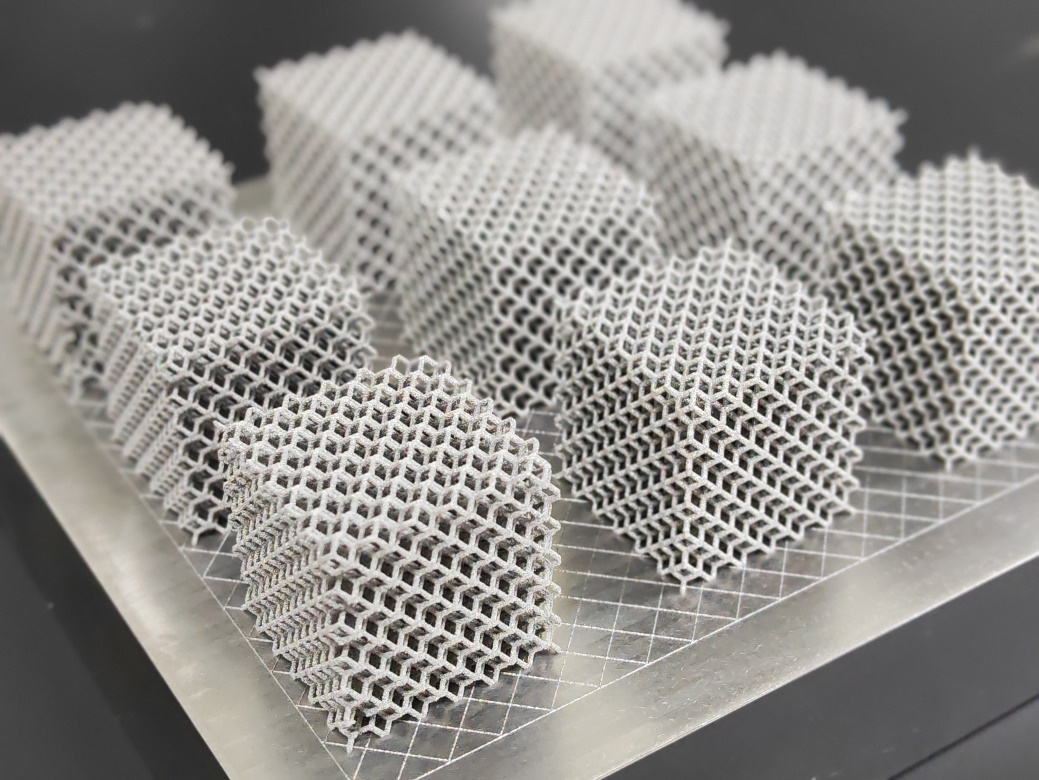
Medical implants are a primary application for Titanium TC4. Its biocompatibility, non-toxic behavior, and corrosion resistance allow it to be used in orthopedic implants, dental implants, and surgical instruments. Furthermore, 3D printing enables the production of porous structures that promote bone ingrowth, a key advantage in modern implant design.
Inconel 718 finds its niche in tooling applications, such as injection mold inserts and manufacturing and tooling for high-temperature environments. The alloy’s wear resistance and ability to maintain dimensional stability under thermal cycling make it suitable for challenging industrial conditions.
Conclusion: How to Select the Right Alloy for Your Strength Requirements
Choosing between Inconel 718 and Titanium TC4 depends on your application’s specific performance needs. If your custom part must operate under extreme temperatures, mechanical loads, and fatigue cycles, as in turbines or aerospace engines, custom superalloy 3D printing with Inconel 718 provides unmatched strength and durability.
If your project prioritizes weight reduction, corrosion resistance, and biocompatibility, such as in aerospace structures or medical implants, titanium 3D printing with TC4 is the clear choice.
By understanding the metallurgical and mechanical differences between these alloys, engineers can make informed material selections that optimize performance and lifecycle cost. Advances in custom stainless steel 3D printing also offer complementary options for specific use cases.